Table of Contents
ToggleMost homeowners never think about their refrigerator temperature until food starts spoiling or the unit runs up a utility bill. The right setting is crucial, it’s the difference between bacteria multiplying on your groceries and keeping them fresh for days. Many people assume their fridge is working correctly just because it’s cold, but guessing wrong wastes money and puts your family’s health at risk. This guide walks you through what temperature your refrigerator should be, why it matters, and exactly how to dial in the perfect setting for your kitchen.
Key Takeaways
- Your refrigerator temperature should be set between 35°F and 38°F (ideally 37°F) to safely slow bacterial growth while preserving food quality.
- Use an inexpensive appliance thermometer to measure your actual refrigerator temperature, as guessing based on how cold it feels leads to food waste and health risks.
- Keep your freezer at 0°F (-17.8°C) or below, and remember that adjusting one compartment affects the other on most combined units.
- Bacteria multiply rapidly in the ‘danger zone’ above 40°F, so maintaining the correct refrigerator temperature is your primary defense against foodborne illness.
- Make small adjustments one notch at a time and wait 24 hours between changes to let the unit stabilize and avoid overshooting the ideal temperature.
- Check your refrigerator and freezer temperatures twice a year—once during hot weather and again in heating season—to ensure optimal food safety and energy efficiency.
The Ideal Refrigerator Temperature Range
Your refrigerator should be set between 35°F and 38°F (1.7°C to 3.3°C). This is the safe zone recommended by the USDA and FDA for storing perishable foods. If your fridge runs warmer than 40°F, bacteria like Listeria and Salmonella grow rapidly. If it dips below 32°F, you risk freezing produce and dairy at the front of your shelves while the back stays too warm.
Why this specific range? It’s cold enough to slow bacterial growth dramatically, almost halving it for every 5-degree drop, but warm enough to prevent damage to most fresh foods. Most modern refrigerators have a dial or digital control numbered 1 to 5 or displayed in actual temperatures. The middle setting (usually labeled 3 or around 37°F) hits the sweet spot for most households.
Keep in mind that the temperature fluctuates slightly when you open and close the door, and different shelves have slightly different zones. The back and lower shelves tend to be colder than the upper shelves and door. This variation is normal and part of how refrigerators are designed.
Why Temperature Matters for Food Safety
Temperature is the primary tool for controlling bacteria growth in your fridge. Bacteria don’t multiply when food is frozen, but they thrive in the “danger zone”, between 40°F and 140°F. Your refrigerator’s job is to keep food cold enough to dramatically slow this growth, extending shelf life while keeping your family safe.
When a fridge runs too warm, spoilage bacteria and pathogenic bacteria multiply faster than you’d notice by smell or sight alone. Listeria, for instance, grows even at refrigeration temperatures if it’s above 40°F: dairy products, deli meats, and cooked leftovers are particularly vulnerable. Recent studies on food safety show that maintaining the correct temperature reduces foodborne illness risk significantly.
Setting your fridge too cold (below 35°F) wastes energy and can freeze sensitive items like leafy greens and cheese. It also increases your utility costs without adding safety benefits. The key is consistency, holding steady at 37°F does far more for food safety than fluctuating between 35°F and 42°F.
Freezer Temperature Settings
Your freezer should sit at 0°F (-17.8°C) or below. At this temperature, almost all bacteria stop multiplying entirely, and food stays safe indefinitely (though quality does decline over time due to ice crystals and oxidation).
The relationship between freezer and fridge temperatures is linked on most units, adjusting one affects both. If your overall appliance temperature control is set too high to keep the freezer at 0°F, your fridge will also run too warm. Conversely, if you crank the dial all the way up to freeze foods faster, your fridge compartment may become dangerously cold and waste energy.
Check your freezer thermometer regularly if you’re unsure. Freezers in consistent use should maintain 0°F to -10°F without much fluctuation. If your freezer runs warmer than 0°F, ice cream softens, frozen vegetables lose texture, and the safety window shrinks. Modern refrigerator-freezer combos often have a separate freezer dial or a percentage split setting that lets you balance both zones without one dominating the other.
How to Check and Adjust Your Refrigerator Temperature
Using a Thermometer
The only reliable way to know your fridge temperature is to measure it, not guess based on how cold it feels. Grab an inexpensive appliance thermometer (analog or digital, typically $5–$15) and place it in the middle of the fridge, ideally on a shelf near the center. Leave it there for 8 hours or overnight, then read the temperature. If you want a more detailed picture, place one thermometer in the back (coldest zone) and one on an upper shelf (warmer zone).
Avoid placing the thermometer in the door, where temperatures swing wildly every time someone grabs milk. Don’t stick it in the freezer section if you’re measuring the fridge, use a separate thermometer there. Digital thermometers with external displays are convenient because you can check the reading without opening the door repeatedly.
Adjusting Temperature Controls
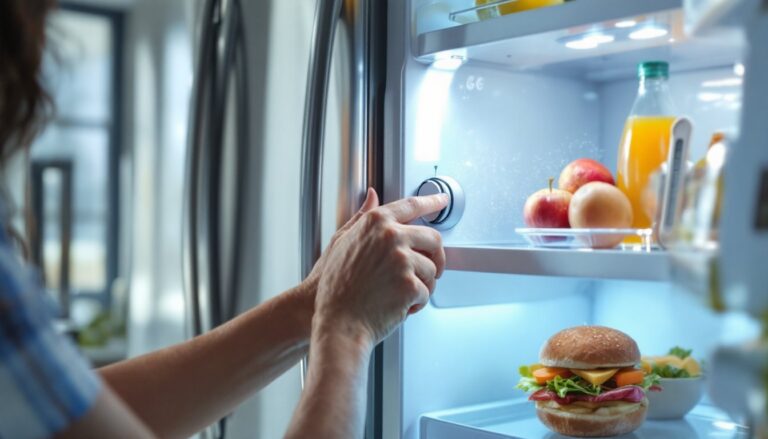
Most refrigerators have a simple dial or digital control inside the fridge compartment, often on the back wall or side wall. The numbers (1, 2, 3, 4, 5) don’t correspond directly to Fahrenheit: they’re relative settings. On a typical dial, turning it from 1 (warmest) toward 5 (coldest) decreases temperature by roughly 2–3°F per number. Start at setting 3 or 4 and measure the temperature after 24 hours to let the unit stabilize.
If the temperature is above 38°F, turn the dial toward the higher number (colder). If it’s below 35°F, turn it back slightly toward the lower number (warmer). Make small adjustments, one notch at a time, and wait a full day between changes so the appliance can settle. Optimal refrigerator temperature settings require patience: quick dial twists often lead to overshooting.
Digital controls display the actual temperature or allow you to set it directly in degrees. If your fridge has this feature, set it to 37°F and measure after 24 hours to confirm it’s accurate. Some modern units have separate controls for fridge and freezer sections, which gives you more precision. If your appliance is old and has no temperature display, a dial is your only tool, invest in that thermometer and dial by feel and measurement, not assumption.
Conclusion
Getting your refrigerator temperature right is one of the easiest and most important maintenance tasks you can do. Set it between 35°F and 38°F, keep your freezer at 0°F or below, and measure with a cheap thermometer to confirm. Small adjustments based on actual readings beat guessing every time. Check it twice a year, once when the weather turns hot and your fridge works harder, and again when heating season kicks in. A few minutes with a thermometer now protects your food, your family’s health, and your wallet.